
The Friends of Ludlow Museum support the Buttercross Museum (run by Ludlow Town Council) and Shropshire Museums Collections Centre (run by Shropshire Council). The Friends of Ludlow Museum support the use and enjoyment of the Museum by the public, in particular by assisting in the purchase of objects and funding the housing and conservation of the collections. The Friends of Ludlow Museum do not have any collections of their own. Information on the the Resources of Shropshire Museums will be found under the link to Shropshire Museums and information on the collections displayed in the Buttercross Museum will be found under the link to the Buttercross Museum.
Their objectives are to support and assist Ludlow Museum and to promote its use and enjoyment by the public as a Museum, and in furtherance thereof:
-
• To stimulate public interest in, and to develop and help preserve, the historical inheritance embodied in the Ludlow Museum Collection.
-
• To encourage and assist the educational aspect of the Museum Service.
• To arrange meetings, exhibitions, lectures, publications, other forms of instruction and publicity, and promotion of schemes of a charitable nature.
•To do all such other things as may be necessary in pursuance of the above objects.
-
• To stimulate public interest in, and to develop and help preserve, the historical inheritance embodied in the Ludlow Museum Collection.
-
• To encourage and assist the educational aspect of the Museum Service.
• To arrange meetings, exhibitions, lectures, publications, other forms of instruction and publicity, and promotion of schemes of a charitable nature.
•To do all such other things as may be necessary in pursuance of the above objects.
Ludlow Museum
Between September and April, a programme of lectures covering a wide range of topics is held on the third Monday of the month at the Collections Centre, starting at 7.30pm. see page ?
The Buttercross Museum is accessed either by the narrow staircase off the pedestrianised Church Street or by the lift located within the open space on the ground floor. It is now open regularly, 3 days a week 10.00-16.00 (Friday, Saturday and Sunday; special arrangements apply on Bank Holidays) For further information on the Buttercross Museum, click here.
Through volunteer work and fundraising the Friends provide help to the Shropshire Museums Collections Centre located in Parkway, under the same roof as the library. For further information on the Resource Centre, click here.
The Collections Centre is where the collections are looked after and stored. They are held in climate-controlled stores and include fossils of international importance and biological material of national note, as well as social history collections relating directly to the county of Shropshire and to Ludlow town.
Volunteer Opportunities
Volunteering
The Friends take an active role in encouraging volunteers to assist in the Shropshire Museums Resource Centre. Individuals undertake a variety of projects with professional guidance. These can range from cataloguing the collections through conservation and research, depending upon skills and availability.
Acquisitions
The Friends of Ludlow Museum have and continue to assist in the purchase of artefacts and funding professional conservation of the collections.
The old mill at the bottom of Old Street, Ludlow.
Image ©SHRMS-2017-00005
This charming painting of the old mill at the bottom of Old Street, Ludlow, close to the junction with Temeside, is dated Nov 1813 (on a stone, bottom left). The Friends of Ludlow Museum have purchased it for the Collection. There is a Thomas Telford plan showing the mill, which confirms its location.
The painting shows a yard, pigsty, stable and the mill. The river is to the right, behind the willow trees.
Unfortunately, the artist is not currently known but further research is being undertaken.
The Ludlow Castle Heraldic Roll of 1576.
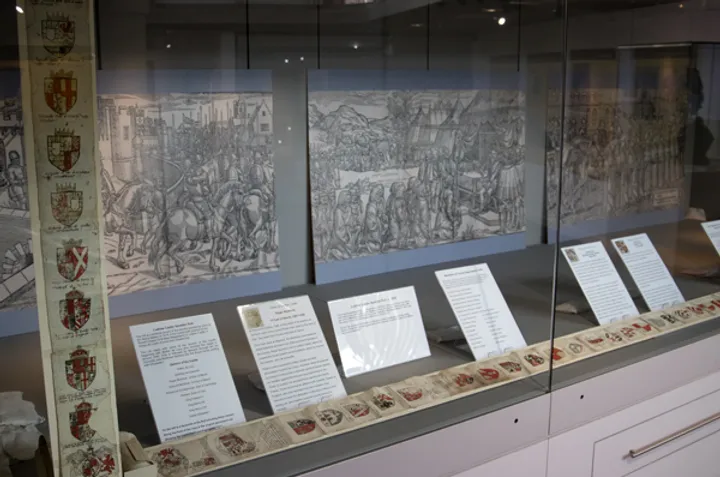
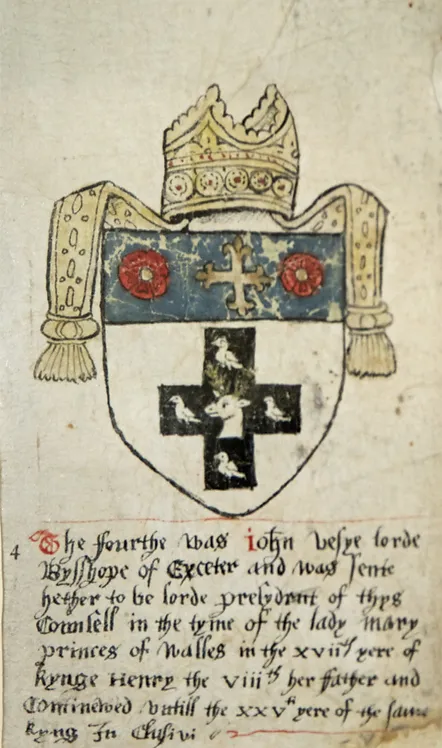
In the late 16th Century Sir Henry Sidney, Lord President of the Council of Wales and the Marches, set up a collection of the coats of arms of a number of people of significance associated with the castle. They were displayed in the chapel of St Mary Magdalene in the inner bailey. As well as including all the current members of the Council, he included the arms of past owners from Walter de Lacy in the 11th Century down to Queen Elizabeth I.
The Council had been set up originally by Edward IV to support his young son Edward who was Prince of Wales. Sir Henry included the arms of all the previous Lord Presidents down to his own time.
A few years later, Sir Henry decided to create a permanent record of these shields. They were copied onto a long roll, made of pieces of parchment, and each one was labelled. Although the original shields are long gone, the roll has survived.
The roll is 15 feet long but just 4 inches wide. Although it is faded in places and rodents have damaged it, it is still in remarkably good condition with bright colours and readable text. Because it is quite fragile, it cannot be displayed permanently in Ludlow, so high-quality facsimiles were created. The original roll is now held by Shropshire Archives in Shrewsbury.
A facsimile is on display in Ludlow Castle bookshop.
www.ludlowcastle.com/the-heraldic-roll
A book has been published on the Roll entitled The Ludlow Heraldic Roll by Rosalind Caird, John Cherry, Philip Hume and Hugh Wood Fircone Books 2017. This is available from Castle Books.